Professional pool vacuum cleaning is the part of pool care most people only notice when it is missing. Skimming clears the surface and the filter polishes the water, but the fine dirt, leaves and algae that sink to the bottom stay exactly where they land until something physically lifts them out. That is the job of a good vacuum pass.
This guide explains what a swimming pool vacuum service includes, why your pool floor collects so much, which signs to watch for, and what to ask before you hire anyone. It is written in plain language for homeowners in Bedford, Hurst, North Richland Hills, Grapevine and Colleyville.
At Sunny Side Pools, vacuuming is one part of our wider pool cleaning services in Bedford, so we see how a dirty floor affects everything above it.
What professional pool vacuum cleaning includes
In simple terms, a vacuum visit removes the debris, sediment and growth sitting on the floor, steps and benches of your pool. It usually works alongside other tasks, so the pool is left cleaner overall.
What gets removed
Swimming pool dirt and debris removal covers leaves, twigs, grass clippings, insects, dust and fine silt. The same pass can lift loose algae and the gritty film that makes a pool floor feel rough underfoot.
How it differs from skimming and brushing
Skimming works the surface, and brushing loosens what clings to walls and steps. Vacuuming picks the loosened material up off the floor so it is not simply stirred back into the water.
What else a visit may include
Professional pool cleaning services often pair vacuuming with skimming, wall brushing, a check of the skimmer and pump baskets, and a look at water balance. Ask what your visit covers so there are no surprises.
Why the pool floor collects so much
Wind, rain, swimmers, pets and nearby trees all carry material into your pool. Heavier pieces sink straight away. Fine particles drift for a while, then settle whenever the pump slows or switches off.
Sediment
Fine silt and dust settle in thin layers. Your filter only catches what travels through the pump, so settled sediment stays on the floor until it is vacuumed or stirred back up.
Algae
Algae often takes hold on the floor and in shaded corners where circulation is weak. Pool algae and sediment cleaning matter together, because decaying organic material gives algae something to feed on and can make your sanitizer work harder.
Vacuuming methods: manual, automatic and robotic
Any swimming pool vacuum service will use one of a few methods, and each has a place.
Manual vacuuming
A vacuum head on a pole is connected by hose to the skimmer or a dedicated port. It gives the operator full control, which makes it the right tool for heavy debris, steps, corners and spot cleaning.
Automatic and robotic cleaners
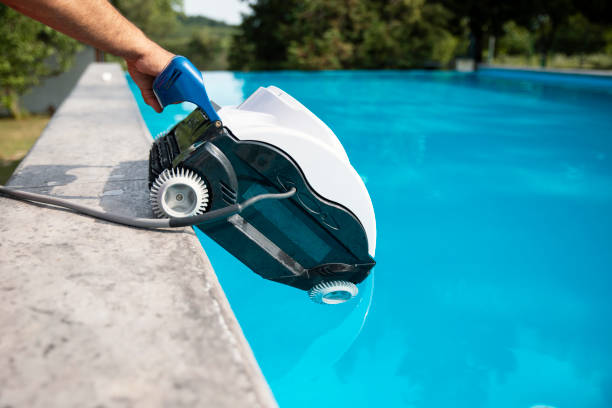
Automatic cleaners move around on their own, and robotic models run from a separate power supply with their own filter. They are useful for routine upkeep between visits, but they can struggle with large debris or heavy growth.
Signs your pool floor needs vacuuming
Pools usually tell you before a problem gets serious. Look for these clues.
What you can see
- Leaves, dirt or a dusty film visible on the floor or steps.
- Dull, hazy water even when your chemicals test as balanced.
- Green patches or dark spots on the floor and in corners.
What you can feel
- A slippery or slimy floor underfoot.
- A gritty, sandy texture on steps and benches.
After a storm or a windy day, look over the deep end and the corners first, where debris gathers fastest. Removing a pile of leaves early is far easier than dealing with growth later.
Urgent vs. can wait: how to sort floor problems
Not every dirty floor needs a same-day call. Use this table to sort what you are seeing.
| What you notice | What it may mean | Priority |
|---|---|---|
| Water so cloudy you cannot see the bottom or main drain | Heavy sediment, growth or a water balance problem | Book now Keep everyone out of the pool until it clears. |
| Water turning green, or slimy growth covering the floor | Active algae growth | Book now It spreads quickly. |
| A large pile of leaves or storm debris on the floor | Heavy organic load | Book now Remove it before it breaks down. |
| Floor feels slippery or gritty underfoot | Biofilm or built-up sediment | This week Vacuum and brush soon. |
| Automatic cleaner stuck, stalled or with a full bag | Clogged or blocked cleaner | This week Clear it and check the equipment. |
| Fine dust on the floor and water still clear | Normal settling | Can wait Handle it at your next visit. |
| A few leaves in a corner after a breezy day | Routine debris | Can wait Net them out or leave them for your next visit. |
If you are unsure which row fits, treat it as the more urgent one and ask a professional.
Pool floor vacuuming: a step-by-step overview
Some homeowners vacuum by hand between visits. These steps are general, so your equipment manual has the final word.
A pump can be damaged if it runs dry or with air in the line. Keep every electrical cord and power supply away from water, follow your equipment manual, and keep swimmers out of the pool while you vacuum. Never mix pool chemicals. If something feels unsafe or unclear, stop and call a professional.
- Skim and empty the baskets. Remove floating debris, then empty the skimmer and pump baskets so water flows freely.
- Check the water level. It should sit high enough to cover the skimmer opening, or the pump may pull in air.
- Assemble the vacuum. Attach the vacuum head to the pole and the hose to the head.
- Prime the hose. Hold the hose under water until bubbles stop, then connect it to the skimmer or vacuum port.
- Vacuum in slow, overlapping passes. Moving slowly lifts debris instead of stirring it into the water.
- Handle fine debris with care. If your system has a waste setting, your manual will say when to use it. Otherwise expect to clean the filter afterward.
- Finish up. Disconnect the hose, empty the baskets, check the filter and let the equipment dry.
What affects the cost of pool vacuum service
Every pool is different, so a fair provider looks at your pool before giving an answer. The main factors are:
- Pool size and shape. More surface and more steps mean more time.
- Amount of debris. A few leaves are a different job from a pool buried after a storm.
- Algae and sediment. Heavy buildup may need brushing and extra passes.
- Surroundings. Trees, wind and landscaping affect how fast the floor gets dirty.
- Frequency. A one-time cleanup and a recurring schedule are set up differently.
- Equipment condition. A blocked filter or weak pump can slow the work.
- What is bundled in. Brushing, skimming and water treatment can be part of the visit.
Sunny Side Pools offers free estimates. Whoever you hire, ask for the scope of work in writing.
How to choose a pool vacuum service provider
A good provider makes the work easier to understand. Look for these signs:
- Licensed and insured. Ask for confirmation.
- A clear scope. Know what each visit includes before it starts.
- Plain-language reporting. You should know what was found and what was done.
- A whole-pool view. Floor, walls, baskets, filter and water balance affect each other.
- Reliable scheduling. Visits happen when you were told to expect them.
- Local knowledge. A nearby team knows the debris your pool faces.
Want to see where we are based? You can find Sunny Side Pools on Google Maps and get directions or contact details.
Prevention tips for residential swimming pool maintenance
Good residential swimming pool maintenance is a steady rhythm, not occasional rescue missions:
- Skim regularly and empty the baskets so debris never piles up.
- Brush walls and steps before vacuuming so loosened dirt is picked up.
- Run circulation as recommended so fine particles stay moving toward the filter.
- Keep water chemistry balanced to limit algae and cloudiness.
- Check your automatic cleaner and empty its filter or bag when needed.
- Schedule regular professional visits so small problems stay small.
Service areas
Sunny Side Pools serves homeowners across the Mid-Cities. Pick your area for local pool cleaning and maintenance details.
- Hurst, TXPool cleaning & maintenance
- Bedford, TXPool cleaning & maintenance
- North Richland Hills, TXPool cleaning & maintenance
- Grapevine, TXPool cleaning & maintenance
- Colleyville, TXPool care from Sunny Side Pools
Frequently asked questions
How often should a pool floor be vacuumed?
It depends on nearby trees, weather, pool use and what kind of cleaner you have. Heavy leaf seasons need more attention, and a provider can suggest a schedule after seeing your pool.
Is a professional vacuum different from an automatic pool cleaner?
Automatic cleaners help with routine upkeep, but they may not lift heavy debris or growth. A professional can handle those jobs and also check the rest of the pool.
Can vacuuming remove algae?
It can pick up loose or dead algae, especially after brushing and treatment. Living algae also needs proper water treatment, so vacuuming alone is not a fix.
Do I need to drain the pool before vacuuming?
Normally not. Pools are vacuumed while full. Do not drain a pool without professional guidance, because an empty pool can be damaged.
Why is the water cloudy right after vacuuming?
Fine particles can be stirred up or pass into the filter, which then needs time or cleaning to catch them. If the cloudiness lasts, have the filter and water chemistry checked.
Which areas does Sunny Side Pools serve?
Sunny Side Pools serves Bedford and nearby Mid-Cities communities, including Hurst, North Richland Hills, Grapevine and Colleyville.
Ready for a cleaner pool floor?
Tell us what you are seeing and we will help you work out the next step. Sunny Side Pools is licensed and insured, and we offer free estimates.
Check our business listing
Prefer to look us up first? Find Sunny Side Pools on Wireanium.